When we awakened on the morning of our departure to Hawaii, the outside air temps hovered in the single digits Fahrenheit with a dusting of frozen snow on the ground.
Snow over the Rockies
Thankfully, our Boeing 777-200 plane left on time with 372 people reportedly on board, including the two pilots and eight crew members. The pilot announced that every seat was filled! The seven-hour direct flight from Denver to Kahului went well, but we did have several long stretches of turbulence that interrupted dinner service.
During the flight, I read an entire book for my March book club, “The Life Impossible” by Matt Haig. So I’m ahead of the game! The novel’s fantasy trip theme seemed to weave right into our own impending adventure.
We arrived in the late afternoon Maui time (Hawaii Standard Time, which is three hours earlier than our usual Mountain Time). Our expected rental car, though, could not be located. I’ll spare the ugly details, but after almost two hours without securing transportation, we ended up taking an Uber to our rented condo, and we also called in Uber Eats for a late Mexican dinner. The food shopping at Costco would have to wait until the morning, when John nabbed a different rental car—the last one to be located on the island from any dealer.
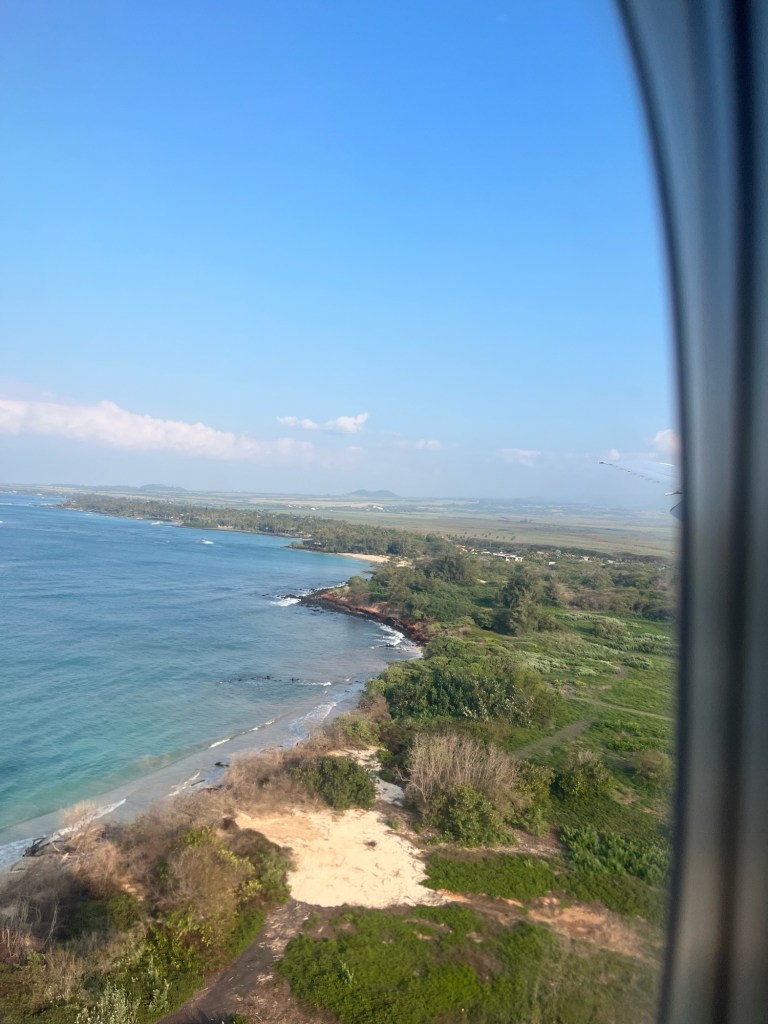
First view of Maui from the plane
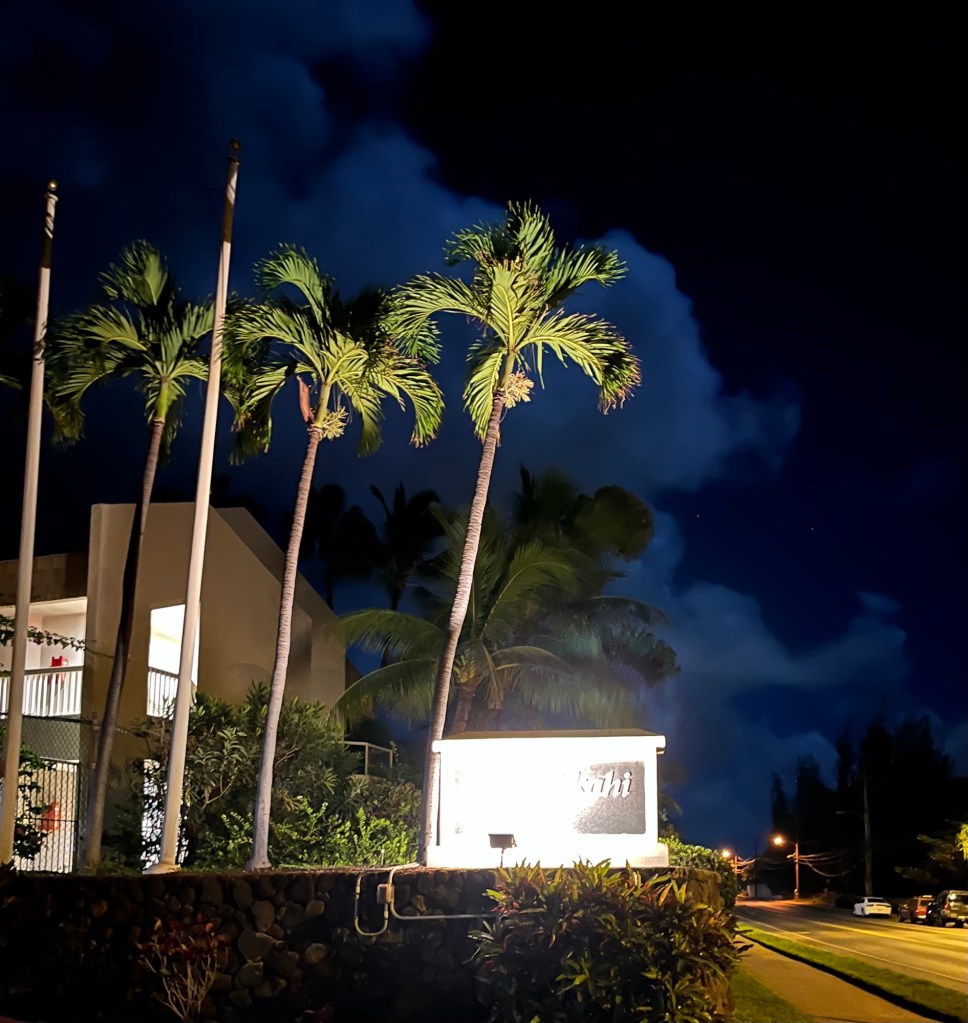
Entrance to our rented condo in Kihei…right across from the beach!
Sleep did not last long, as we had a 2:55 a.m. pickup by a Valley Isle van to go on a sunrise excursion up the third tallest mountain in Hawaii—Haleakala, which means “House of the Sun.” It has become a popular destination to stand at the peak watching the sun rise above the cloud layer each morning. Haleakala is a dormant volcano, and it is around 10,000 feet above sea level.
Even with the fleece-lined parkas supplied by the tour company, my own winter gloves and hat—as well as three layers underneath the parka—could not keep out the cold winds as we stood for an hour awaiting the full sunrise experience. I will say, though, that it was quite worth the wait and a bit surreal as the sun rose to hear a lone park ranger singing the traditional Hawaiian morning chant.
What an experience!
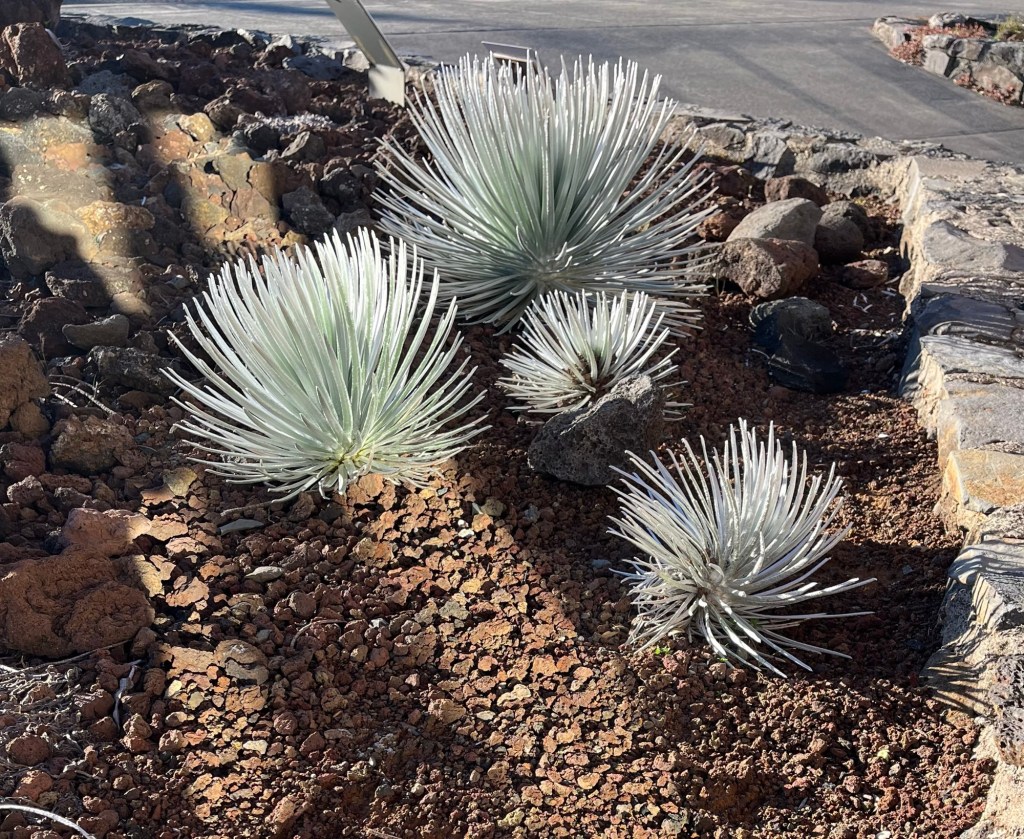
On the way back down the mountain, we spotted several silver sword plants that only blossom once, then die. This rare species is native to the slopes of Haleakala but not in any other place on earth!
Silver sword plants
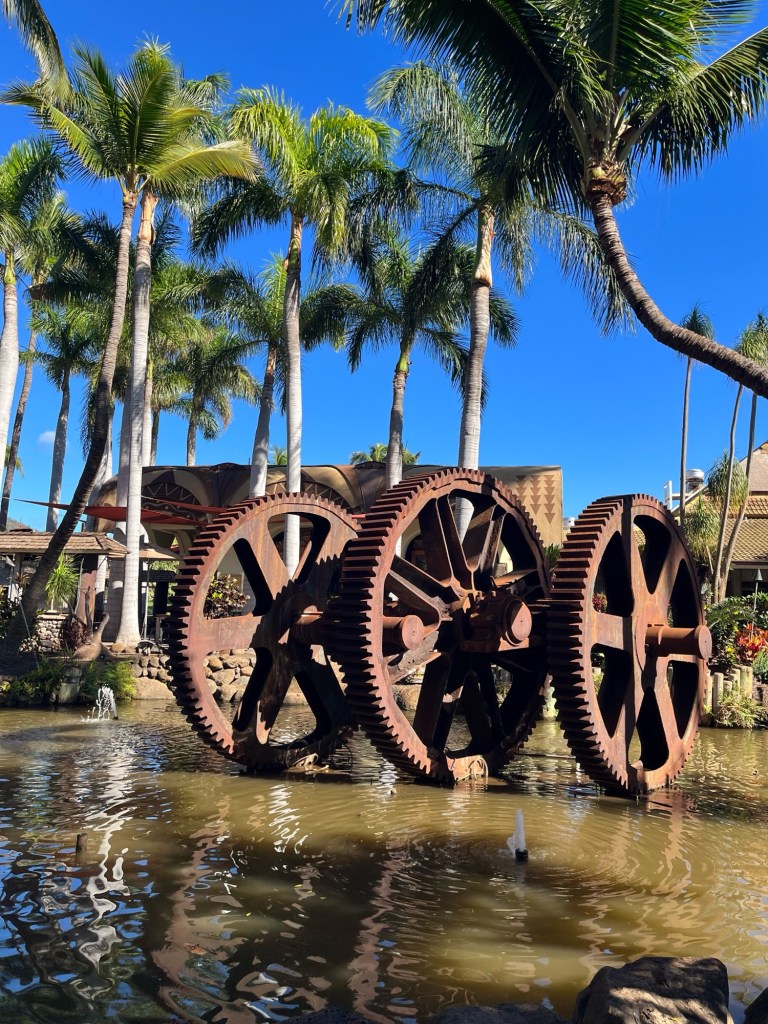
We enjoyed a hearty breakfast at the beautiful Maui Tropical Plantation. Some of the local items on the menu included macadamia nut pancakes, coconut syrup, and POG juice (passion fruit, orange, and guava). I enjoyed the juice so much that we bought a container later at Costco after we took yet another Uber to—finally!—grab our hybrid rental car.
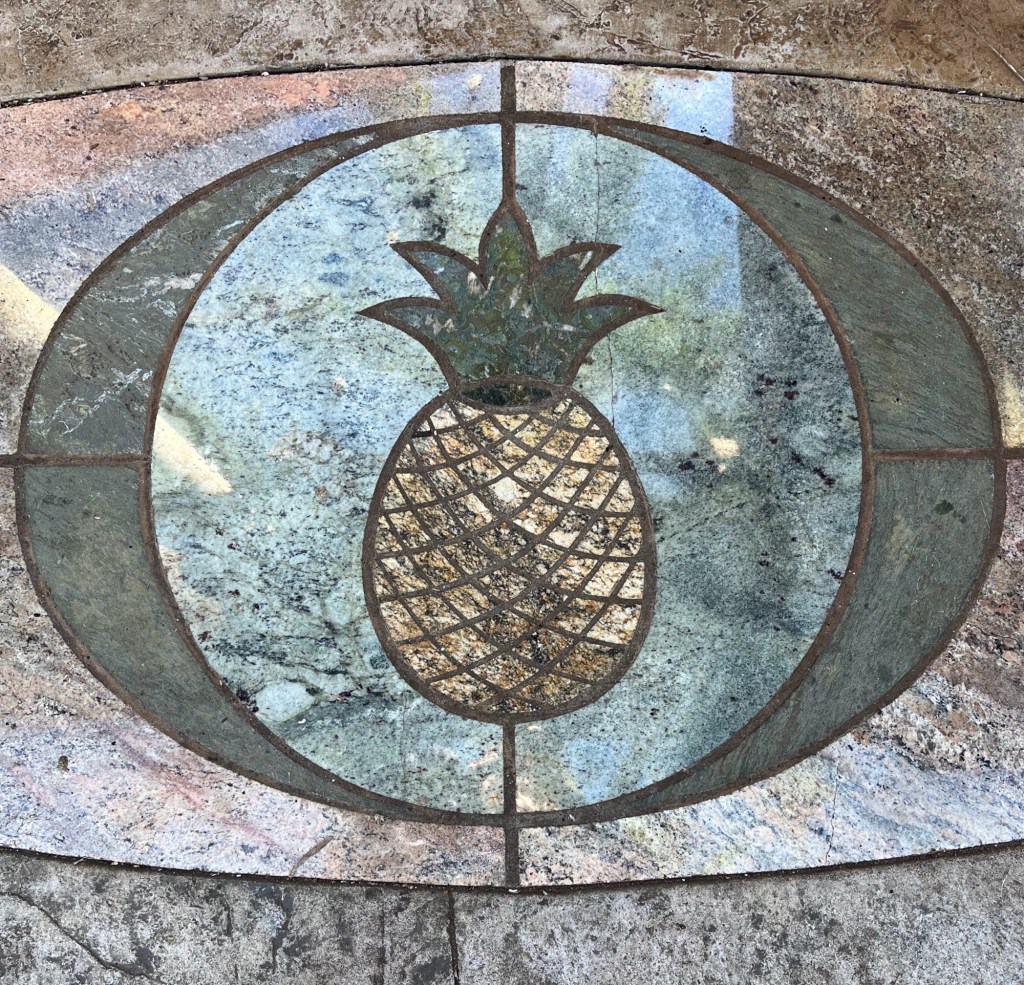
Beautiful motif on the floor of the plantation restaurant
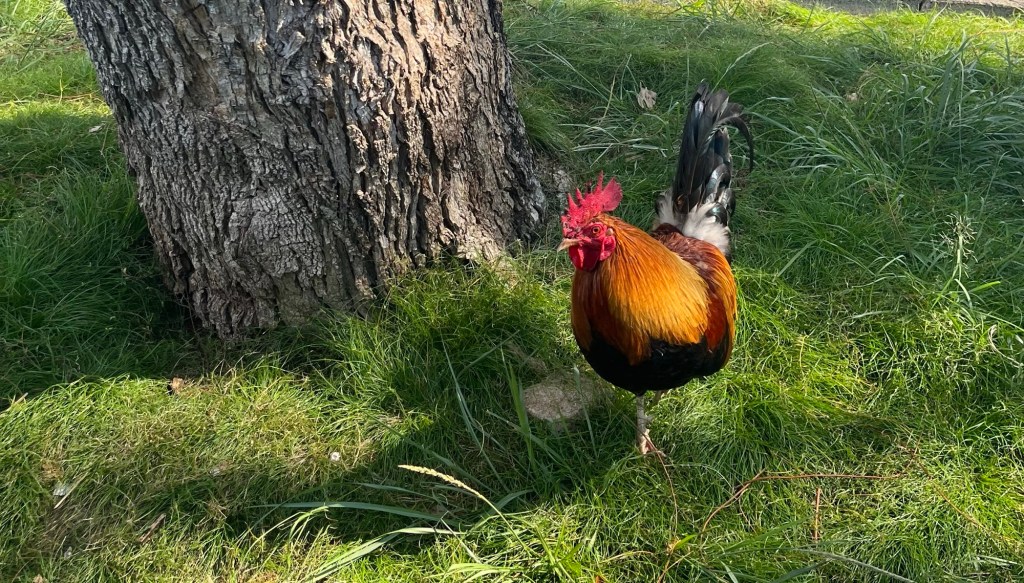
Like other places around the world, bird flu has led to mass chicken killings. Eggs cost $10 a dozen here! Yet I found it ironic that chickens and roosters seem to be plentiful here on the island of 735 square miles (48 miles long and 26 miles wide). Birds of all kinds wake us each morning, and it’s not unusual to see chickens wander across roadways. (Yes, the chickens really do cross the road to get to the other side….)
Another common sight is solar panels. I’d estimate that at least 80% of the residences have solar panels. There’s also lots of wind generators located on one side of the northern mountain range. Less than 15% of the electricity is generated from wind, though. Reliance on fossil fuels is still strong.
We ended the evening early after I cooked a meal of stir-fry rice, chicken, and veggies in a teriyaki sauce.
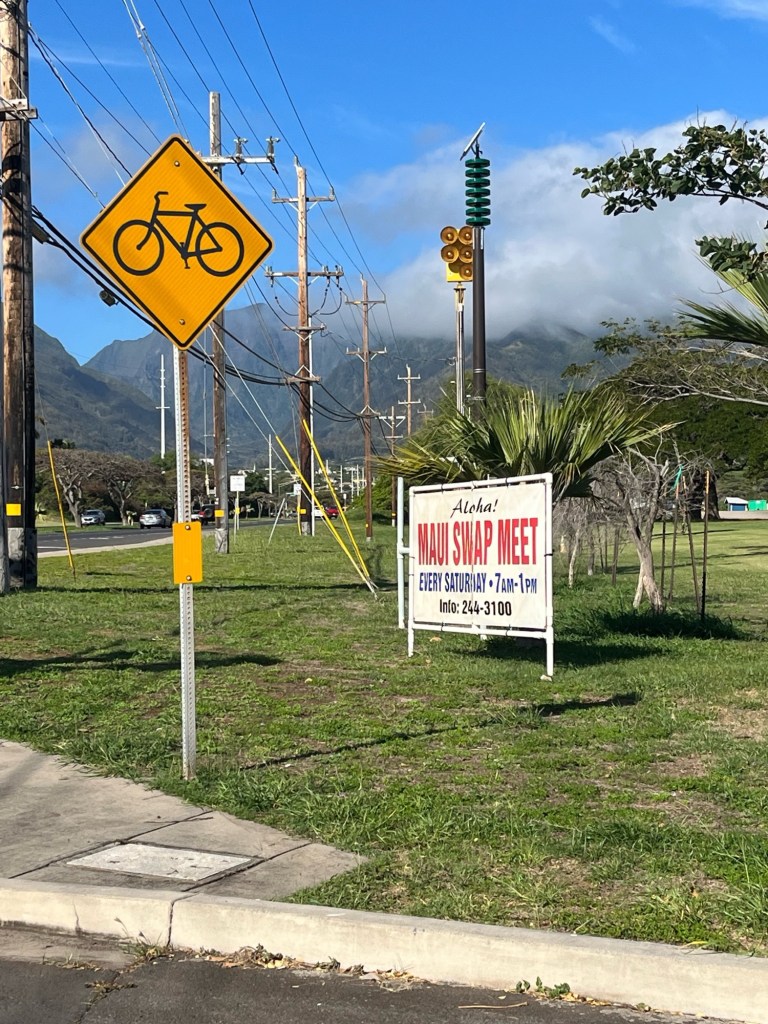
We ventured out early to a big swap meet on the campus of Maui College, part of the University of Hawaii system. Supporting the local economy is important to us as we travel, so we bought handcrafted items from several artisans—a clay/seashell bowl, a painted canvas bag, a hand-dyed t-shirt, an Aloha shirt, and a tropical Christmas ornament.
Lots of vendor booths here!
Next we began exploring the north shore, then drove southward through the middle of the island to “upcountry” cowboy country. Oprah reportedly has a secret hideaway in this remote area near the town of Kula. Sometimes the winding road reminded me of traveling through rural West Virginia, and we saw cattle and horses on ranch land surrounded by rock walls serving as fences.
Banyan tree
We stopped to walk through Makawao, a former cowboy town settled by Japanese two centuries ago and now considered a tourist trap with eclectic art galleries and boutiques. We walked into a bakery that has been owned for over 100 years by the same Japanese family.
One shop in Makawao
I had packed a picnic lunch for us to eat, and we decided to stay in our car with the windows rolled down. A nearby flock of chickens must have heard us chewing, because they surrounded the vehicle whining and clucking for food. Right before we left, I threw a single grape out the window. A battle erupted, so I’m not sure which lucky duck won the lottery! 🙂
The beggar
We drove through Kula and paused to explore a funky little park with at least four statues that commemorated Sun Yet-Sen, the late 19th and early 20th century founder of the Republic of China.
Sun Yet-Sen
I noticed several open-air buildings like tall carports, one being the Hawaii Cowboy Church overlooking Maui halfway up Haleakala Mountain.
In his research for the trip, John found a guided tour that is synced to the car’s GPS. The speaker will relay fascinating history as the listener drives through the areas detected by GPS. I laughed out loud when he actually BURPED while educating us about luaus.
We drove in and out of rain clouds and bright sun, but other than a few random raindrops, it never really rained.
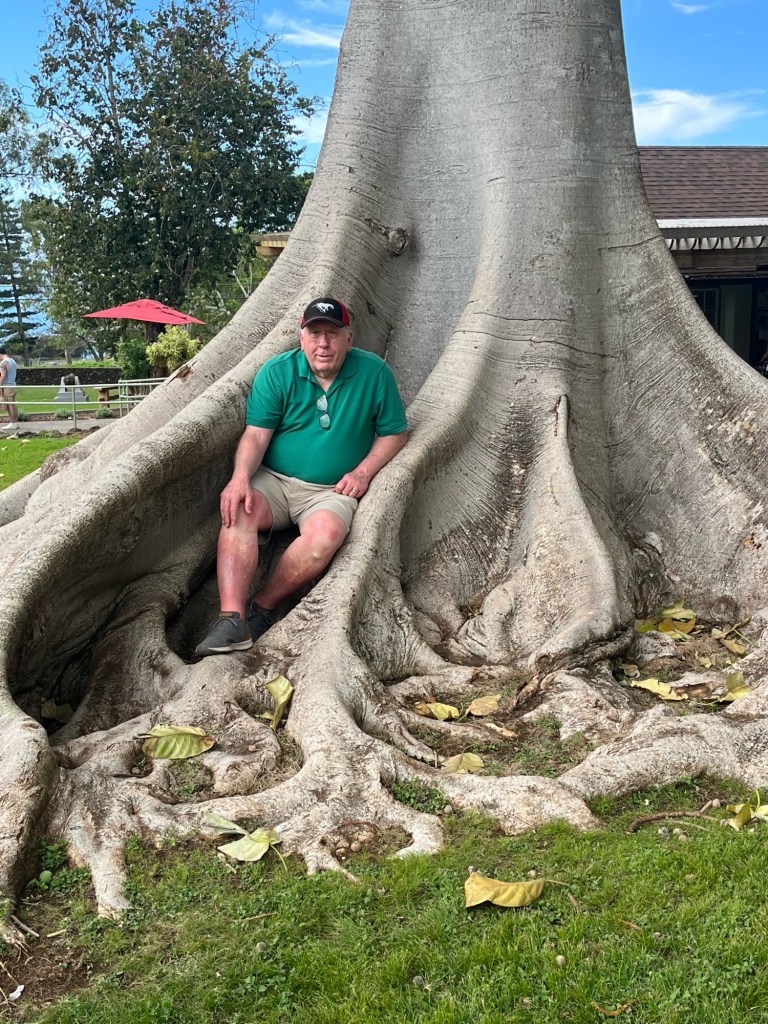
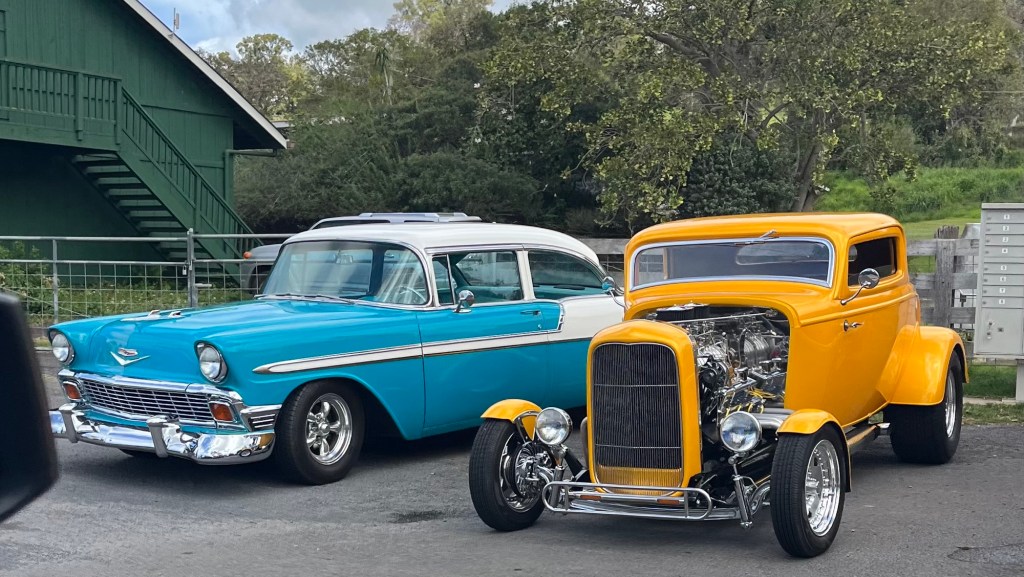
Stopping at Maui Wine Co. proved to be a welcome respite. I took a photo of John nestled into the roots of a huge banyan tree, and we bought a bottle of pineapple wine. We also saw some classic cars parked nearby.
At Maui Wine Co.Classic cars are always fun to see!
We learned from the guy talking on the oral travel guide that there are no longer sugar plantations on Maui, as it’s a labor-intensive crop now harvested in third-world countries in order to remain economically feasible. Hawaiian agriculture has become much more diversified.
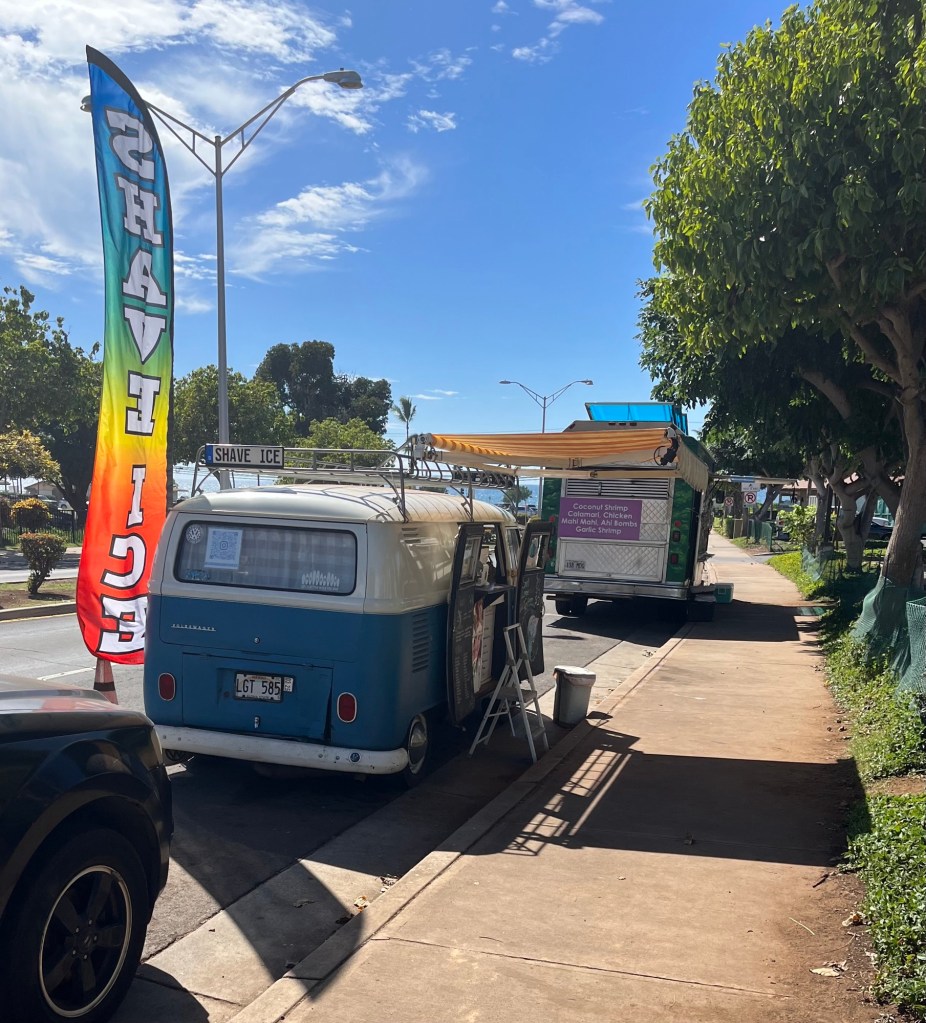
I’m not gonna lie. We had to check out several “Shave Ice” places while in Maui. It became our favorite treat at the end of almost every daily excursion. It’s like snow cones but far better!
I think our bodies are still on Mountain Time, so since we were both awake at 5:30 a.m., we watched our Denver church service being live-streamed.
After breakfast, we drove southward through Wailea, a ritzy resort and golfing community. We then went through a protected lava field (Ahihi-Kina’u Natural Reserve) that showed actual lava rocks hardened from two volcanic explosions between 400-600 years ago.
Lava flow hardened into rocks
In the afternoon, we went north again to find the boat dock in Maalaea for tomorrow’s whale-watching excursion.
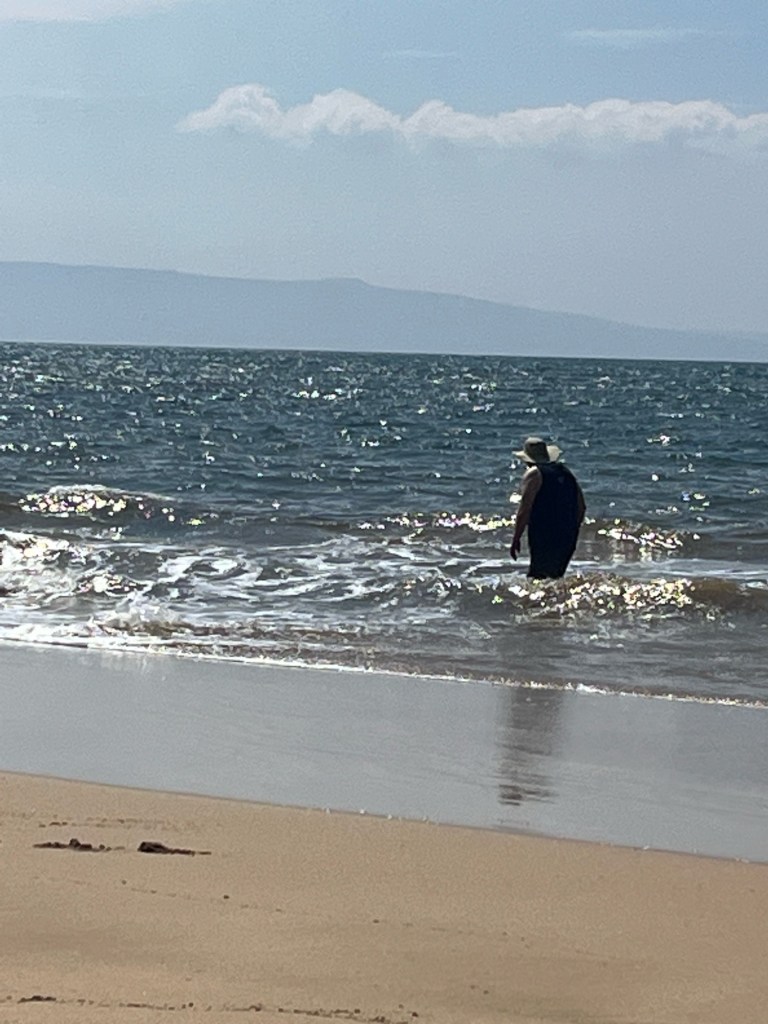
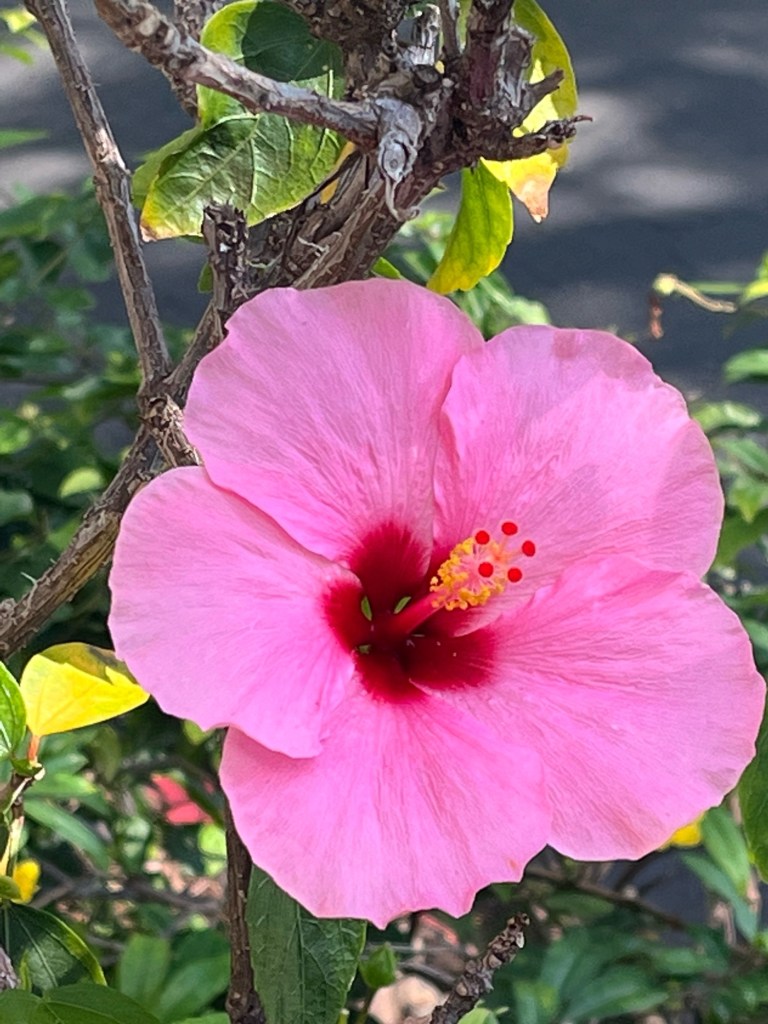
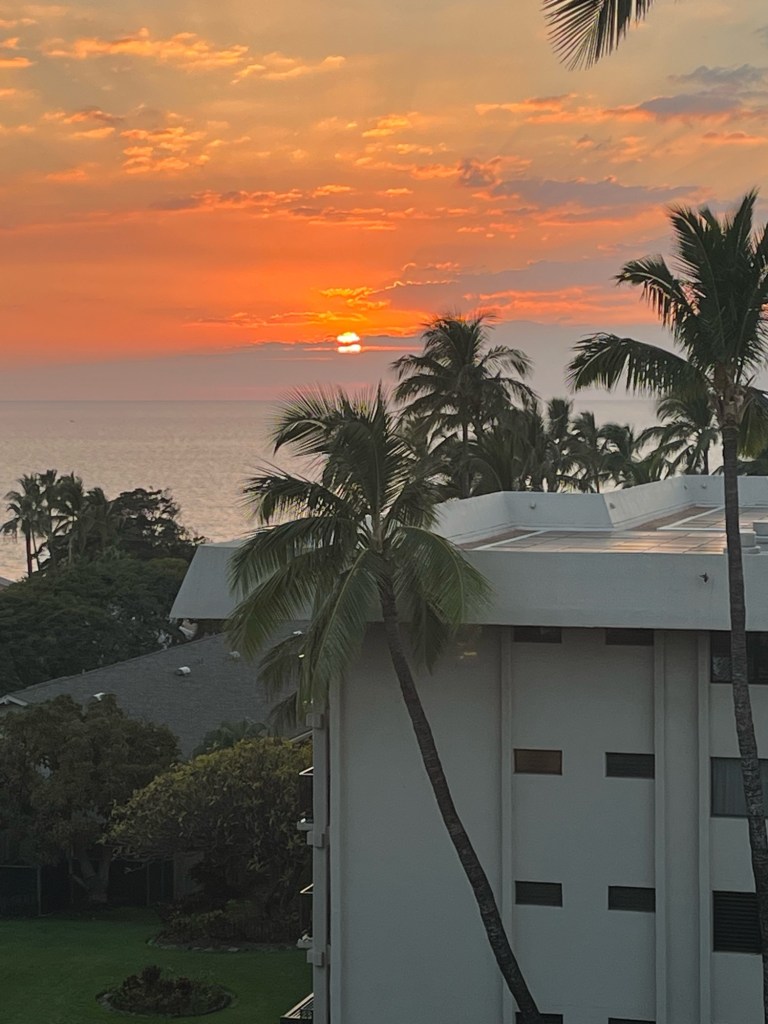
Taking photos of the beautiful flora around our rented condo—and walking onto the beach each evening to watch sunsets over the ocean—became daily rituals. Enjoy my photo dump!
John wading in the Pacific OceanSpider lilyHibiscusAnother beachDaily sunsetsOur balcony
John’s birthday began rather frustratingly. He couldn’t successfully pay for the parking (via QR code/credit card) next to the Maalaea Harbor. Rather than check in late at the Sail Maui boat slip for a whale-watching expedition, we gave up and ran down the hill so we wouldn’t be late. Sure enough, there was a ticket tucked under our wiper blades when we returned three hours later.
Waiting to board
We actually found it funny, though, because on my 70th birthday (Black Friday), a cop pulled over John in New Mexico for a speeding ticket, and now on his 70th birthday shared with Presidents’ Day, he received a parking ticket.
I digress. Back to the whales.
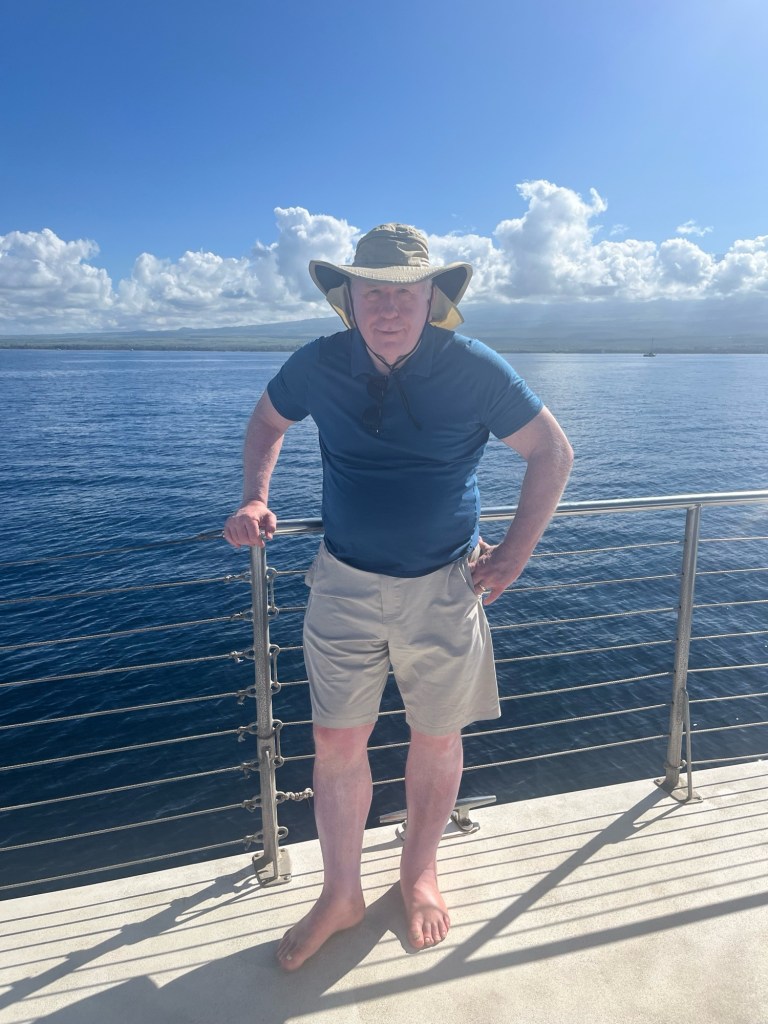
John chose Sail Maui from among the numerous whale-watching excursion companies to book reservations, because it was one of the displaced Lahaina companies after their horrific fires—and because it also caters to a smaller crowd (around 30 people) on a 64-foot catamaran. Last time I remember being on a boat? Over five years ago on the Sea of Galilee in Israel, September 2019.
The birthday boy!
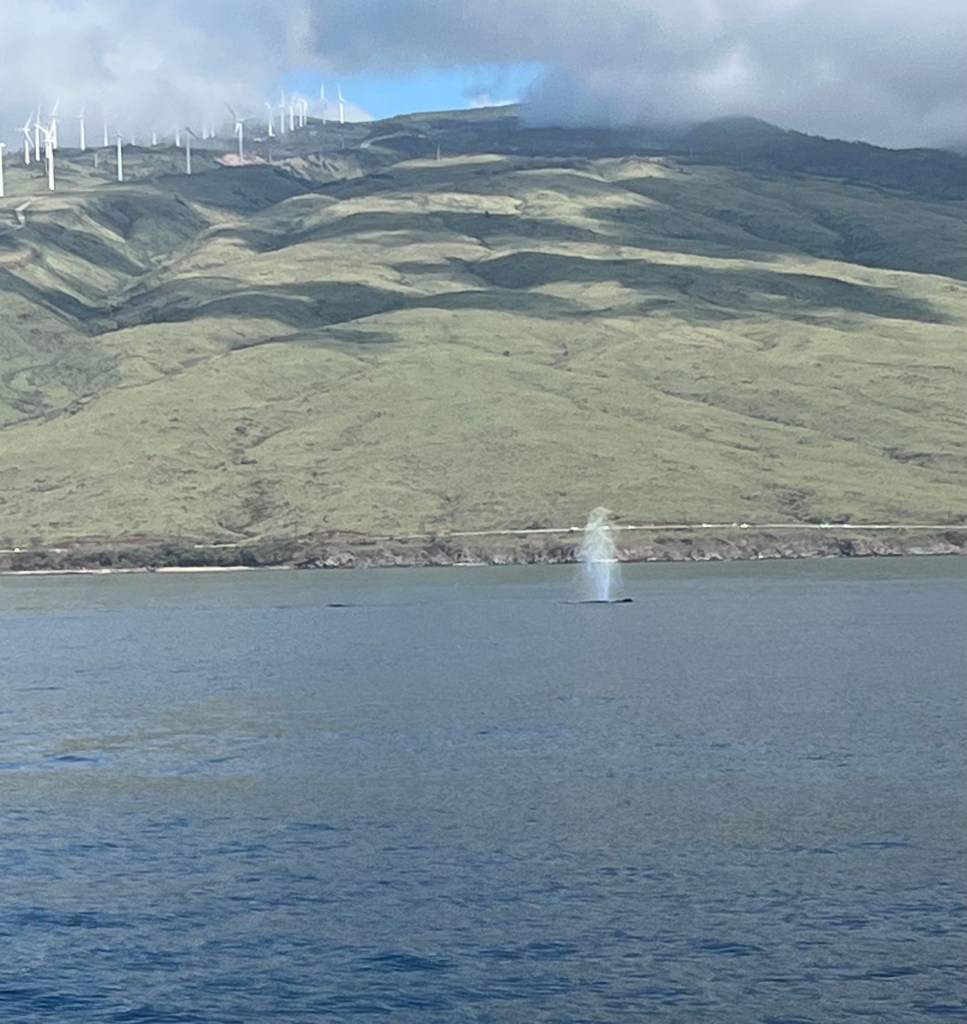
The morning turned into a success. The joke was that we saw at least 70 humpback whales to help celebrate John’s 70th birthday. Seriously, though, we must have have seen dozens—none jumping spectacularly out of the water, but many mostly flipping their tails, showing their backs, and blowing air from their blowholes.
Humpback blowing air
This time of year is definitely the best window to see whales as they winter in Hawaii between December and April. Then they return to the waters off Alaska. We watched a pod of males fighting for the attention of a female where they trumpet, menacingly blubber, and blow air.
We also saw at least two baby (calf) whales swimming alongside their mothers. A calf puts on weight daily, sometimes up to 100 pounds a day! Their mother’s milk is 50% fat, and it’s necessary to pack on the pounds to have enough “insulation” before returning to the colder waters off Alaska.
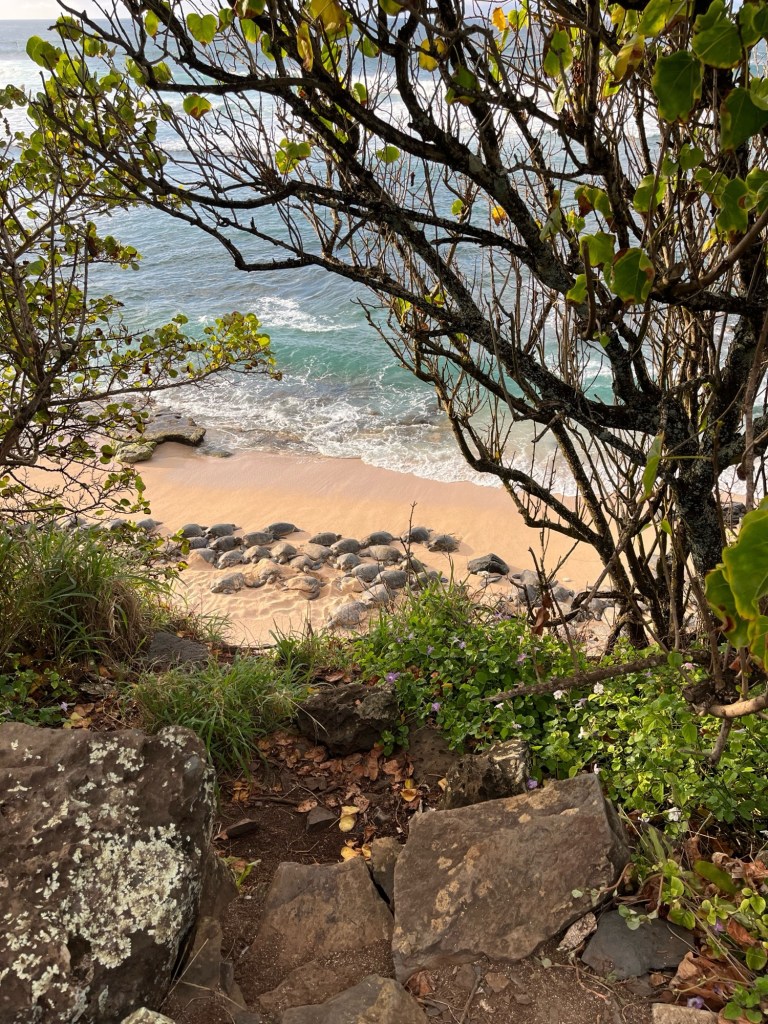
After returning to shore, we drove eastward through the oldest road tunnel in Hawaii all the way to the Nakalele Blowhole, then turned back to avoid increasingly bumpy roads. A welcome stop came at the beautiful D. T. Fleming Beach and then the Ho’okapa Park to watch sea turtles crawl onto the beach. We witnessed about a dozen turtles sunning themselves on the beach.
Nakalele Blowhole
As we listened to the audio tour, we learned that the volcano on the west part of the island is extinct, but the one on the east side is dormant and could erupt again.
Before embarking on another Valley Isle van tour, we joined eleven fellow passengers back at the Maui Tropical Plantation for a breakfast of fruit and muffins.
Maui Tropical Plantation
The road to Hana is a narrow, treacherous road that has the most tropical plants I’ve seen in one place! Condensed into a rain forest area, many of the plants were new to me.
I learned from native Hawaiian van driver/guide Joe that there are several types of banyan trees. Ones that look groomed are different from those in their natural state with many branches hanging down.
John with Joe, our knowledgeable driver and guide
Monkeypod trees originally came to Hawaii from the Philippines, and Captain James Cook brought to the islands the aptly named Cook pine trees. African tulip trees arrived from South Africa over a century ago and have beautiful orange blossoms. Giant bonsai trees (nicknamed as such) also originated from South Africa.
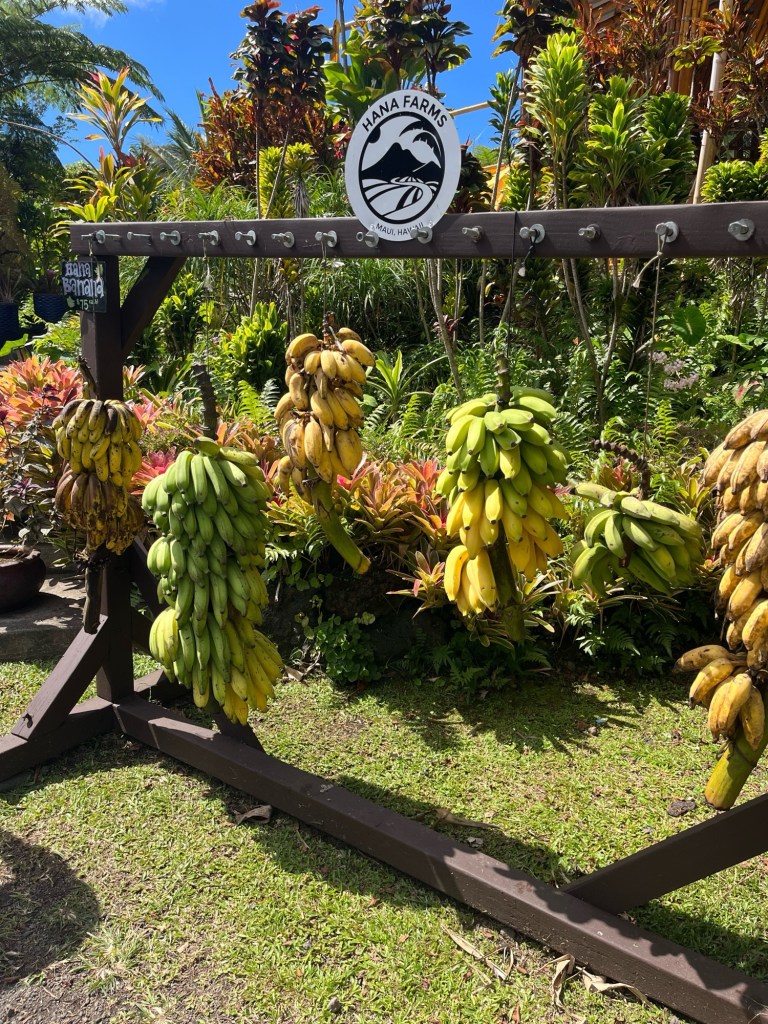
Mango trees can grow very large, and their fruit ripens in summer. (Guide Joe gave us his mother’s recipe for pickled mangoes!) Other trees with edible fruits included bananas, papayas, breadfruit, coconuts, and avocados.
Bananas, one of many types of fruit in Hawaii
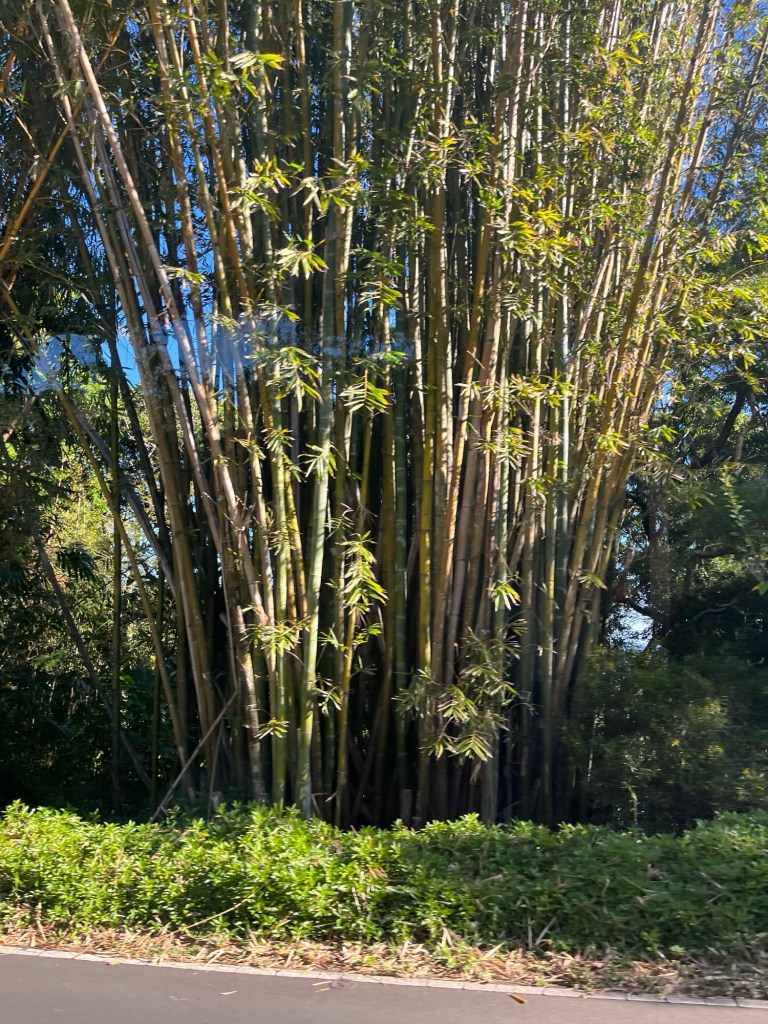
Bamboo plants are prolific, and there are many types, including the smaller diameter Japanese bamboo.
A larger type of bamboo trees
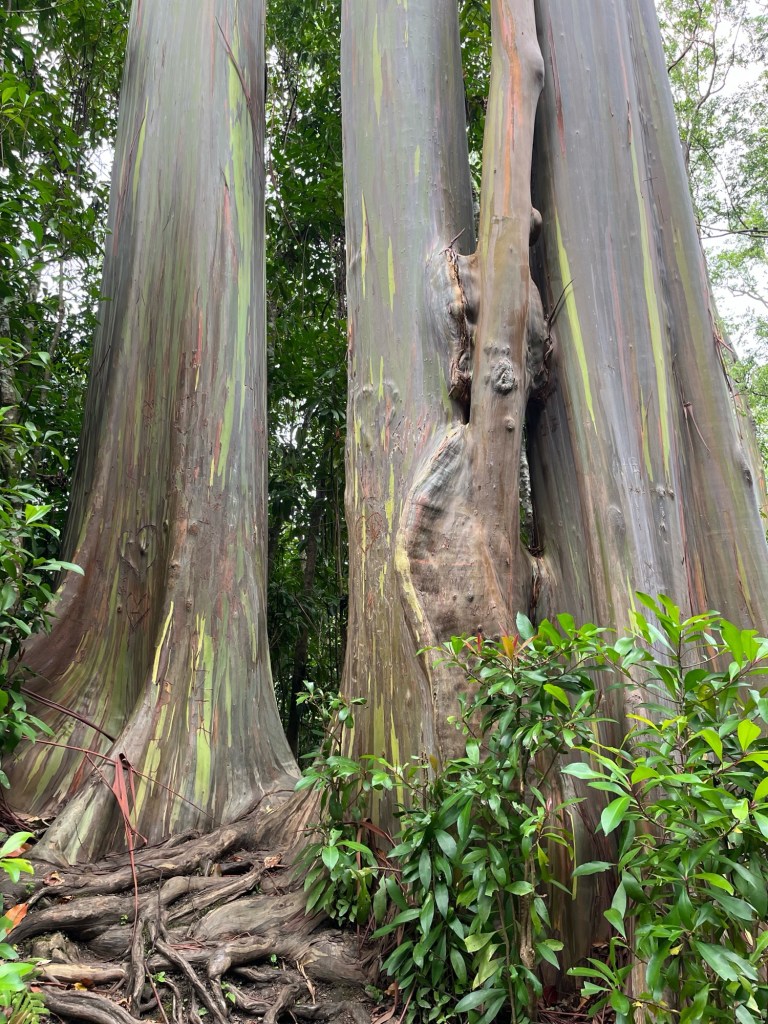
By far, my favorite plant was the rainbow eucalyptus tree with their random stripes in many colors dripping down the bark. Another type of eucalyptus, the twisted bark trees, were often covered in split-leaf rhododendron. Other plants growing around trees (like kudzu in the Deep South) were the morning glories with a plethora of white blossoms every morning. Large-leaf plants often tucked between trees were giant elephant ears called ape (ah-pay) in Hawaiian.
Rainbow eucalyptus
Some of my favorite beautiful plants included the nicknamed lollipop flowers and decorative tea plants (not edible) that come in a variety of brilliant colors.
Ginger blooms year-round, but it has white blossoms in winter and red and pink in summer.
On the road to Hana, we went over 54 narrow stone bridges, many of them built over mountain streams with gorgeous waterfalls.
One of many waterfalls
We stopped once to take photos of a stunning rainbow, but even though it misted occasionally, we never experienced rain.
Rainbow!
One of the most memorable stops came at Wa’anapanapa State Park where there’s a black sand beach and huge, colorful leaves from the kamani trees. According to our guide Joe, this big-leaf plant is like a “fake almond tree” where the skin of the nut is edible but the nut itself has to dry up first to eat at a later time.
Kamani tree leavesBlack sand beach
Places we drove along the north shore of Maui included Opana Point, Uaoa Bay, Kaumahina State Wayside, Ke’anae Point, Pu’a Ka’a State Park, and Nahiku where three celebrities had lived (George Harrison, Jim Nabors, and Kris Kristofferson). Oprah has also bought more land on the coast near Hana—presumably to keep it in its natural state and away from developers.
Near our returning point, we stopped by Ho’okipa Park (for us, the second visit) where we witnessed dozens of sea turtles basking in the sun. Some of the biggest waves for Maui surfing are at this beach, too.
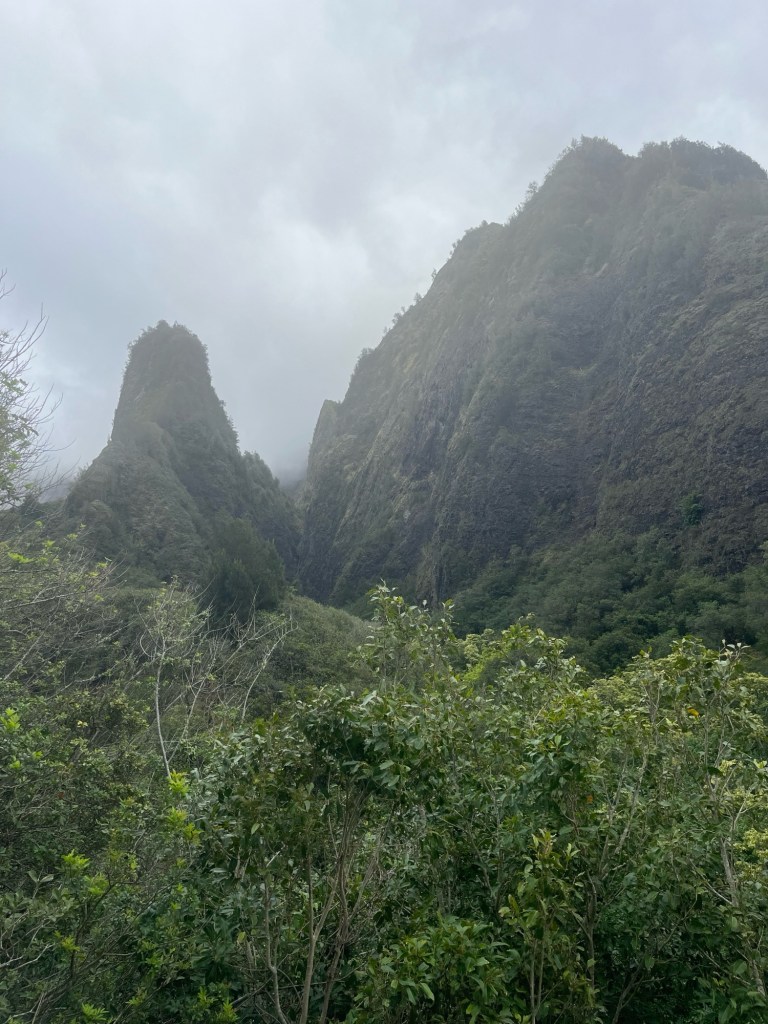
John had made required reservations to go to Iao Valley, part of the state park system, which is reportedly the wettest part of the United States. About an inch of rain a day falls here. It’s also a fascinating historical site of the biggest battle in Hawaiian history.
After hiking to the observation point in cloudy but non-rainy conditions, reading some historical markers, and taking photos, John took me back into town to check out two quilt shops. Let’s just say I filled my purposefully planned, previously empty carry-on suitcase with the goodies from each shop. One shop was probably the smallest I’d ever been in, while the other had to be the largest!
The wettest valley in the U.S.
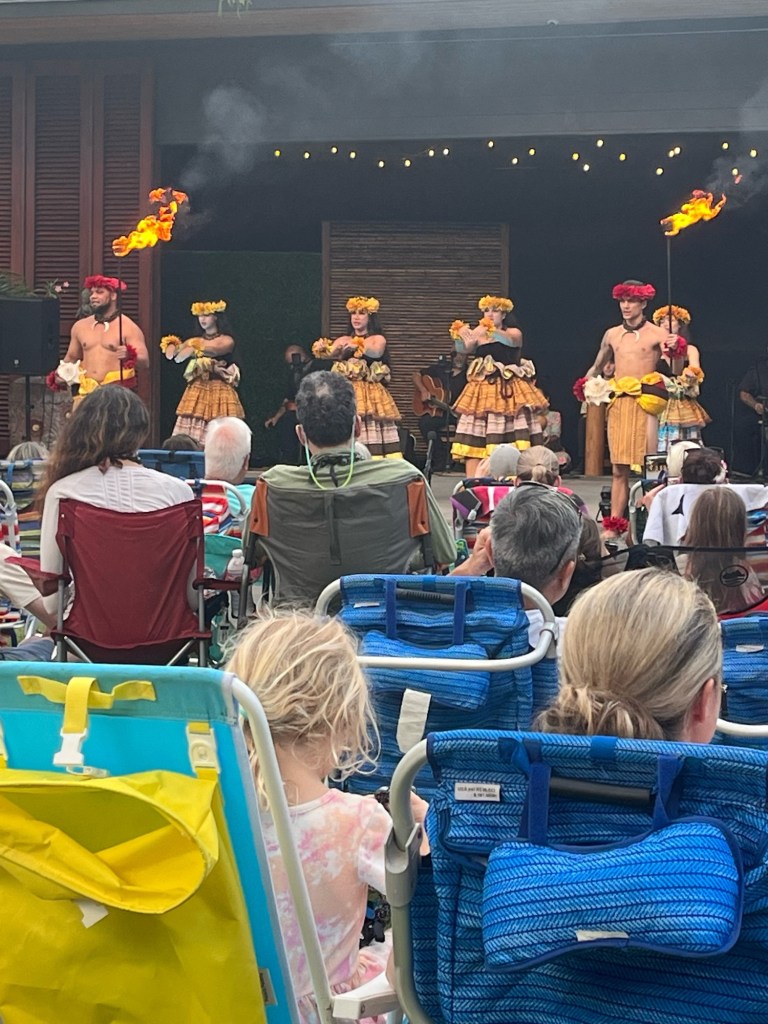
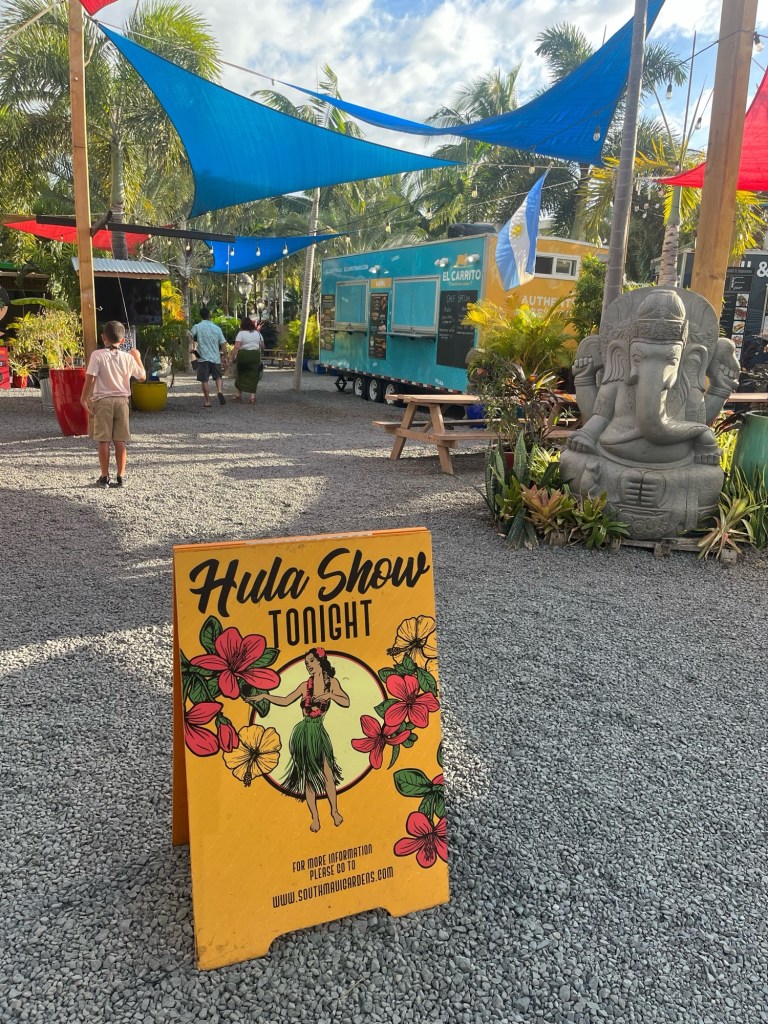
We spent the evening at South Maui Gardens for a hula show, and we wandered the nearby food trucks for supper. Rather than paying $300 each for a luau, this venue offered a similar hula/fire dancer show for 1/3 the cost.
While waiting for the show to start, I did a half-hour Zoom call with my quilt show steering committee. Work can be mixed with play!
Today I washed two loads of clothes, packed, and enjoyed some social media reading with the balcony doors open. It’s too hot to sit outdoors, but with the ceiling fan going in our rented condo—and the westward-facing view not warming up until afternoon, the open doors let in some welcome breezes.
For lunch, we ate at Nalu’s Grill, where patrons stand in line outdoors, then order and pay at the open-air front desk before finding a seat. Unexpected entertainment came in the form of a chicken wandering through the restaurant. When a waitress noticed the bird, she grabbed a water bottle, squirting it while chasing the interloper out of the place.
In the late afternoon, John wanted to try Jollibee, a Filipino-based fast-food chain serving fried chicken and spaghetti adorned with BBQ sauce and hotdogs. The pineapple drink, in my estimation, was unfortunately the only good thing about the place. But at least John’s curiosity was satisfied.
Speaking of Filipino, all three of our Uber drivers this past week were young men transplanted from the Philippines. They were all eager to chat and share something about themselves.
We allowed plenty of time to arrive early at the airport, learning during the wait that it was snowing in Denver. Hopefully, the snow will stop by the time we arrive in the early morning hours.
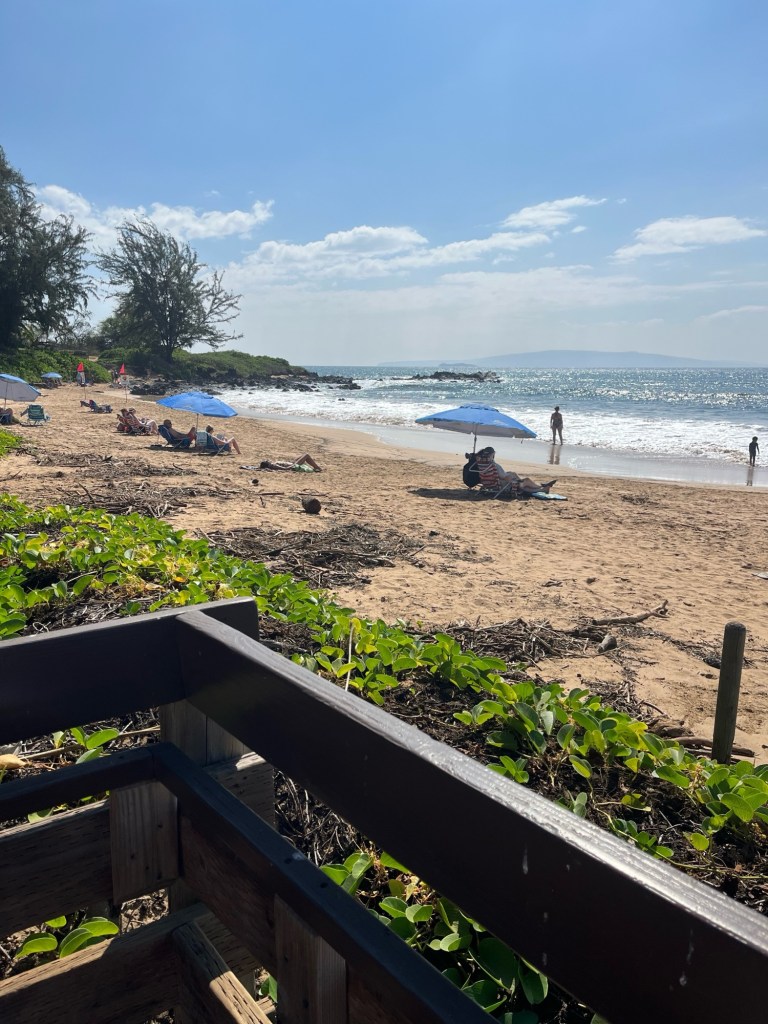
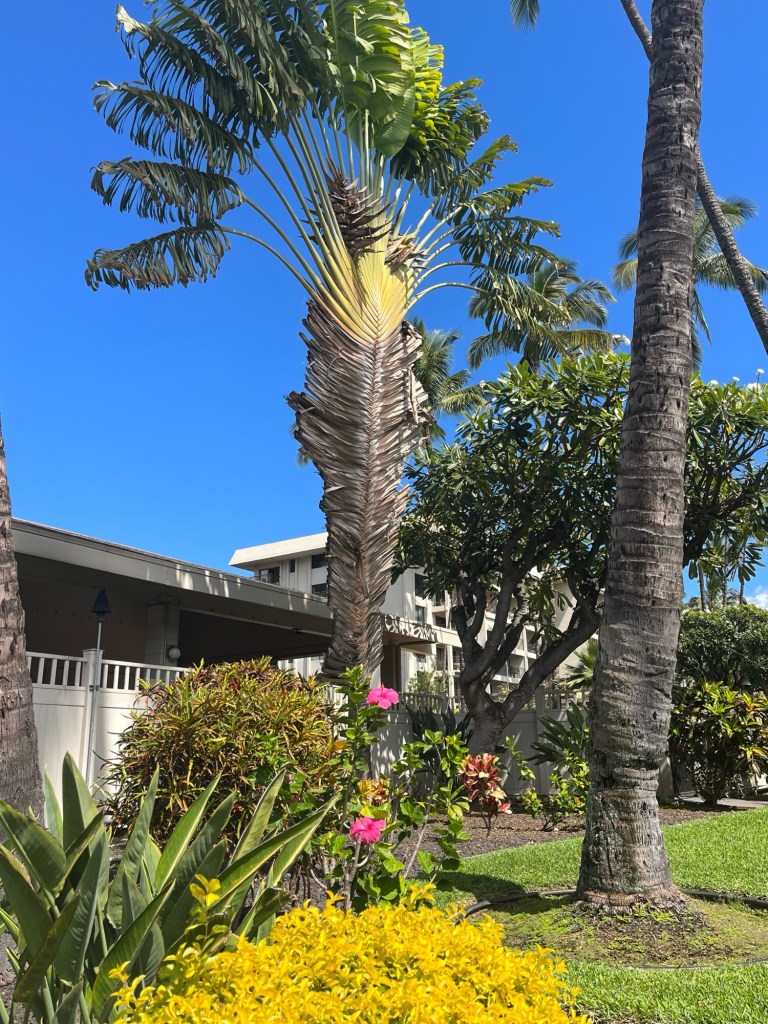
The beach across from our condoSunset view from our balconyTraveler palm and other beautiful plants at our condo
I was surprised at the constant traffic jams and all the tourists. A huge storm caused flooding less than two weeks ago, so one main road was still closed for the clean-up of downed tree limbs and mud-caked vehicles.
Despite the occasional storms, everybody seemingly wants to be in Hawaii this time of year!
Lower-than-expected speed limits appear to be strictly enforced, and in many places we drove over speed bumps, or speed tables, as they are called.
Another thing that slowed down all the traffic were the crosswalks where pedestrians can press a button for flashing lights to stop traffic. Lots of walkers and bicyclists stayed out in the perfect temps that hovered around 80 degrees. We had a little rain shower one night, but the entire week remained basically warm and dry.
I found the food to be interesting—not just the plethora of expected dishes such as poi and sushi, but also the mixture of potato salad and macaroni salad as a popular side dish.
Despite not sleeping well in a lumpy bed—and having an allergic skin reaction to a new suntan lotion, Maui proved to be a good experience overall. I was extremely grateful for not experiencing any gastric distress! If I ever return to Hawaii, I’d like to try exploring a different island.
Aloha!
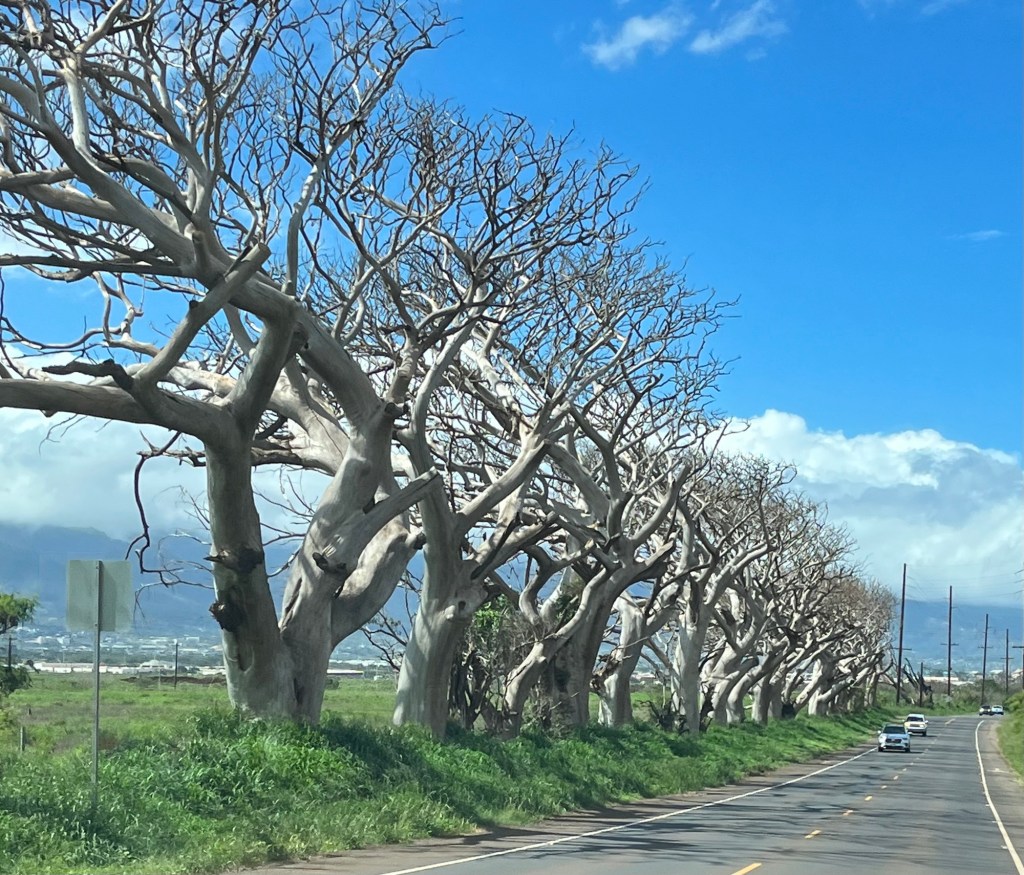
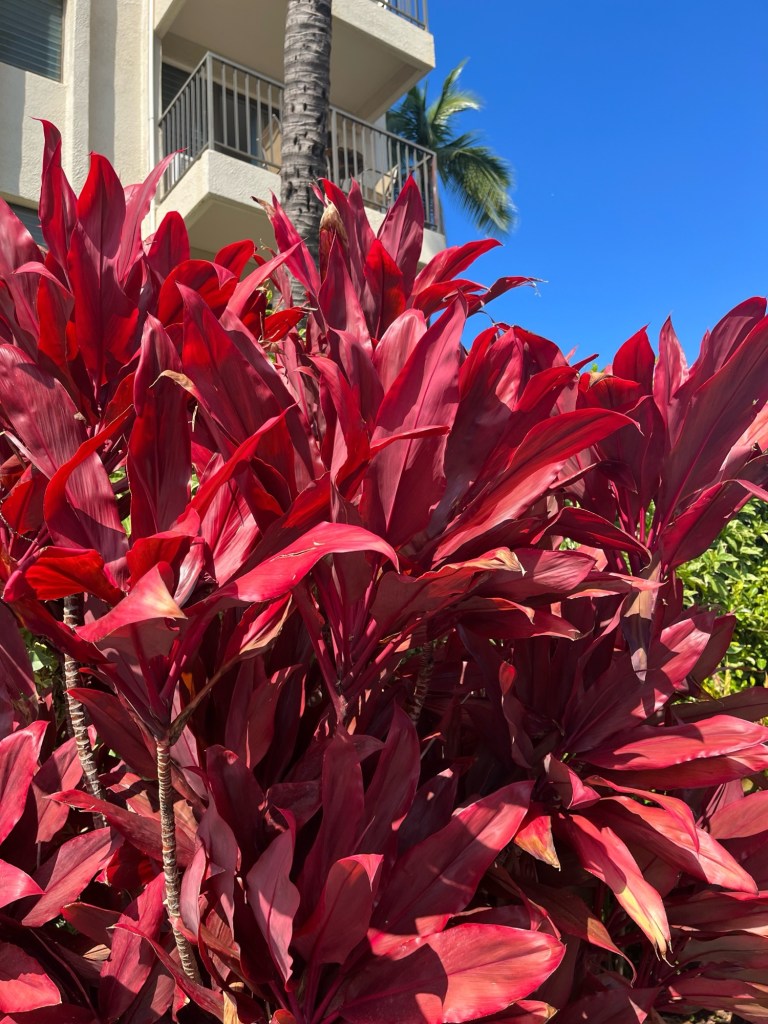
Sunset on the beachOne of many waterfalls on the road to HanaRows of banyan treesColorful plants














 jlmazunikblog